
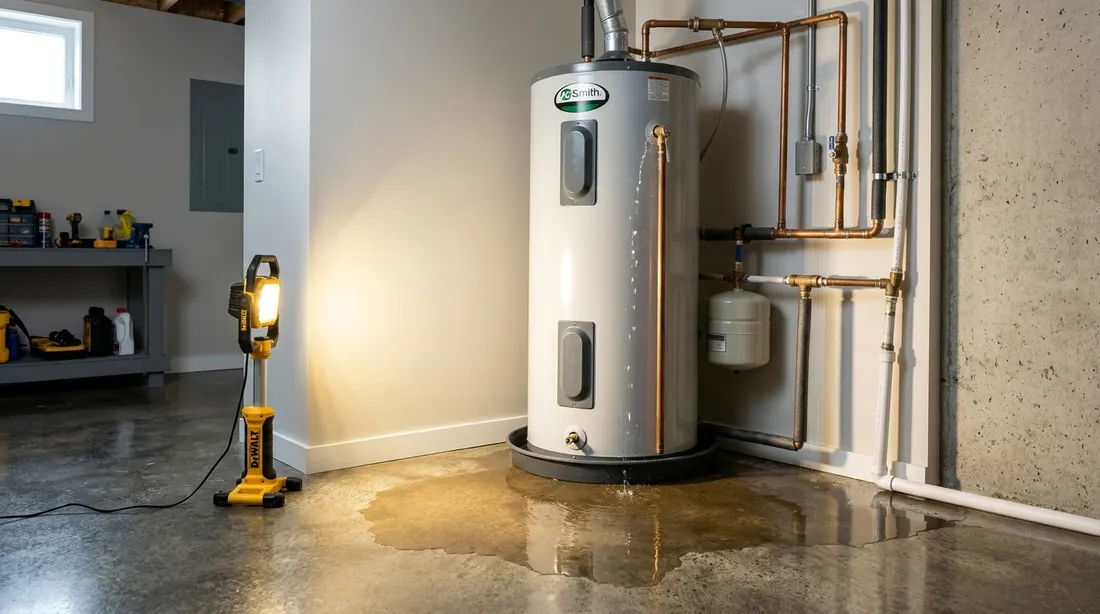
Quick Safety First: What to Do in the First 60 Seconds
Before you grab a mop or touch any pipes, you must stay safe. A leaking water heater combines two dangerous things: gallons of hot water and electricity or natural gas.
Follow these three basic safety rules right away:
- Never Step into Deep Standing Water: If water is standing near an electric water heater, do NOT walk through the puddle. Water conducts electricity. You could suffer a serious shock. Find your home breaker panel first and shut off the circuit breaker labeled "Water Heater."
- Turn Off the Power or Gas: For an electric tank, flip the double-pole circuit breaker to OFF. For a natural gas tank, turn the gas control dial on the front of the heater clockwise to "OFF" or "PILOT."
- Shut Off the Water Supply: Look right above the top of your water heater. You will see a cold water pipe coming down from your ceiling into the tank. Find the valve on that pipe. If it has a straight lever handle (ball valve), turn it a quarter turn until it sits across the pipe. If it has a round wheel handle (gate valve), turn it clockwise to the right until it stops. Shutting this valve stops fresh water from feeding the leak.
Emergency Action Tip
Cannot reach the valve without stepping into deep water? Do not risk your safety. Go to the main water shut-off valve where your water line enters your home (usually in the basement near the front wall or by the water meter) and turn off the whole house water supply. Then call our emergency water heater repair team for fast local help.
Leaking from the Top: Good News, It Is Usually Fixable
If water is dripping from the top metal cover of your water heater, take a deep breath. Top leaks are rarely the end of your water heater. Most of the time, the tank itself is completely fine. The leak is coming from an external fitting, pipe connection, or safety valve that can be replaced or tightened.
Here are the four most common places a water heater leaks from the top:
1. Loose Cold or Hot Water Pipe Connections
Two pipes connect to the top of your heater: cold water going in, and hot water coming out. Plumbers often connect these pipes using flexible stainless steel lines or copper fittings screwed into steel tank nipples. Over years of hot water heating and cooling, metal expands and contracts. Vibrations can cause rubber gaskets to dry out or threaded joints to loosen. Replacing an old flex hose or tightening a union fitting takes less than an hour and stops the drip completely.
2. Temperature and Pressure (T&P) Relief Valve
Near the top or upper side of your water heater, you will see a brass valve with a small metal lever and a copper or plastic pipe pointing down toward the floor. This is the T&P valve. Think of it as a safety pressure valve on a teapot.
If water is dripping from the threads of this valve or coming out of the discharge pipe, one of three things is happening:
- High Water Pressure: City water pressure in Brighton can rise above 80 pounds per square inch (PSI), causing the valve to open and release extra pressure safely.
- Overheating: The thermostat is set too hot or stuck ON, heating water past 210 degrees.
- A Worn-Out Valve: Hard water minerals settle on the rubber seal inside the valve, preventing it from closing tight. Replacing a T&P valve is a quick, inexpensive repair.
3. Thermal Expansion Tank Leaks
In Brighton and Adams County, plumbing code requires a small blue or tan metal canister mounted above your water heater. This is a thermal expansion tank. When water heats up, it expands in volume. The expansion tank has a rubber balloon inside that absorbs this extra water.
When an expansion tank gets old, the internal rubber bladder can tear. Water fills the whole tank, causing heavy rust at the threaded connection on top. If you see water dripping from the expansion tank fittings, you need professional thermal expansion tank replacement to restore proper pressure balance.
4. Sacrificial Anode Rod Port
On top of the heater, there is a large steel hex nut. This nut holds the sacrificial anode rod inside the tank. The anode rod is an aluminum or magnesium metal bar that protects the steel tank from rust. If the threads around this hex bolt corrode or loosen, water will seep out and puddle on top of the tank lid. Having a plumber perform an anode rod inspection will seal the threads and keep your tank protected.
Leaking from the Bottom: When It Means Serious Danger or Tank Failure
Seeing water spreading across the floor from the bottom of your water heater is much more serious. While some bottom leaks are simple parts, others mean the tank has rusted through from the inside and must be replaced immediately.
Here is how to figure out what is leaking at the bottom:
1. The Drain Valve (The Good Outcome)
At the very bottom of the tank, there is a small spigot where you can hook up a garden hose to drain the tank. This is the drain valve. On many factory tanks, this valve is made of cheap plastic. Over time, plastic threads strip or the internal rubber washer breaks down.
Take a dry paper towel and touch the mouth and threads of the drain valve. Is the towel soaked? If water is only coming from the drain valve opening, the fix is easy. A master plumber can drain the tank, remove the plastic valve, and install a heavy-duty brass ball valve that will never leak again.
2. Internal Tank Rust-Through (The Bad Outcome)
Inside your water heater, water is held inside a heavy steel cylinder lined with a thin layer of glass enamel. Over 8 to 12 years of heating hard Colorado water, mineral scale settles at the bottom of the tank. The scale traps heat, creating hot spots that cause the glass lining to crack.
Once water touches bare steel, rust begins eating tiny microscopic tunnels through the metal. Eventually, the water breaks through the outer steel wall. It drips down through the yellow fiberglass insulation and seeps out from under the bottom metal rim.
The hard truth: An internal tank leak cannot be patched, welded, or sealed with glue or flex tape. The tank is pressurized at 50 to 80 PSI. Any patch would blow out immediately. Once the internal tank shell is breached, you must replace the unit. Continuing to run a rusted tank risks a sudden rupture that can dump 40 to 50 gallons of scalding water onto your basement floor in minutes. If you are dealing with a burst water heater right now, shut off your water immediately and follow our ten-minute emergency checklist. If your tank has rusted through, review our options for traditional tank replacement.
3. Top Leaks Trickling Down the Sides (The Great Trick)
Sometimes homeowners think their tank is ruined when it is not! If a pipe on top of the tank is dripping slowly, the water will run down the outer metal casing or slip behind the insulation jacket. The water only becomes visible when it pools on the floor at the bottom.
Before you panic, take a dry cloth and wipe down the top of the heater. Look closely at the top pipe fittings. If the top is wet, your bottom puddle is likely just runoff from an easy-to-fix top leak! Our technicians provide precise leak detection diagnostics to help you avoid replacing a tank that only needs a simple fitting repair.
4. Winter Condensation
During freezing Brighton winters, water from the South Platte River basin enters your home at near-freezing temperatures (often 38 to 42 degrees). When that icy water fills an empty tank, the warm air in your basement condenses on the cold metal, like sweat on an iced drink on a summer day. Condensation drips down onto the burner plate and sizzles. Once the water heats up, condensation stops. If water only appears for 30 minutes after filling an empty tank, it may just be moisture.
Why Brighton Homes Face Extra Water Heater Leak Hazards
Water heaters in Brighton, Colorado work under much harsher conditions than in many other parts of the country. Knowing these local factors helps you protect your home:
- Very Hard Mineral Water: City of Brighton water reports show mineral hardness averaging between 12 and 18 grains per gallon. That is packed with dissolved calcium and magnesium. These minerals settle like concrete stone at the bottom of the tank. The scale eats through factory anode rods in as little as two years, leaving your steel tank walls open to aggressive rust. Regular sediment flushing and descaling is the best way to prevent premature bottom leaks.
- Closed Municipal Plumbing Systems: Brighton's water utility requires backflow check valves on water meters. This creates a "closed loop" in your home plumbing. When your water heater heats water, the expanded water has nowhere to go. Without a working expansion tank, water pressure can spike past 120 PSI, pushing seals open and forcing water out of T&P valves.
- Finished Basements in Brighton Neighborhoods: Many beautiful homes in subdivisions like Brighton Crossings, Bromley Park, and Platte River Ranch have finished basements with drywall, carpeting, and home theaters. A leaking water heater located in an unfinished utility nook can quietly soak carpet pads and cause thousands of dollars in water damage before anyone notices.
Summary Guide: Where Is Your Water Heater Leaking?
Use this quick cheat sheet to understand what your leak means and what step to take next:
| Leak Location | Most Likely Cause | Can It Be Repaired? | Urgency Level |
|---|---|---|---|
| Top pipe threads or flex lines | Loose fittings, worn rubber gaskets, corroded unions | Yes • Fast pipe fitting repair | Low • Fix within 24 to 48 hours |
| Top T&P safety relief valve | High water pressure, overheating, or mineral scale in valve | Yes • Replace safety valve or expansion tank | Medium • Needs prompt plumbing inspection |
| Top expansion tank connection | Failed internal bladder or rusted brass nipple | Yes • Replace expansion tank canister | Medium • Pressure risk if neglected |
| Top anode rod hex head | Loose threads or corroded steel hex bushing | Yes • Reseal or replace anode rod | Low • Inspect and tighten threads |
| Bottom drain valve opening | Stripped plastic threads or broken rubber seat washer | Yes • Replace with brass ball valve | Low • Place bucket under spigot until fixed |
| Bottom seam or outer jacket rim | Internal steel tank has rusted through from hard water | No • Complete tank replacement required | High • Shut off water now to stop flood |
Should You Repair or Replace a Leaking Water Heater?
Deciding whether to pay for a repair or invest in a new water heater comes down to two simple rules: where it leaks and how old the tank is.
Here is how licensed master plumbers evaluate your tank:
- If the leak is on top and your heater is under 8 years old: Repair it! New flex lines, a new T&P valve, or a new expansion tank will cost a fraction of a new installation. Review the typical cost of repairing a leaking water heater to plan ahead. You can expect several more years of dependable service. Look into our affordable traditional storage tank repair options.
- If the leak is at the bottom drain valve: Repair it! Installing a solid brass drain valve will solve the problem quickly without replacing the tank.
- If water is seeping from the tank body itself: Replace it immediately. There are no safe temporary patches for a pressurized tank. If your unit is 10 to 12 years old, spending money on minor repairs is usually wasted because internal rust is already widespread.
When you do replace an aging heater, consider modern high-efficiency options. Today's tanks feature thicker insulation and advanced glass coatings. You can also explore modern tankless water heater installation to eliminate storage tanks completely, free up valuable basement floor space, and enjoy continuous hot water.
Frequently Asked Questions
Can I put flex tape, epoxy, or sealant on a leaking water heater tank?
No, you should never put tape, epoxy, or glue on a water heater tank. A water heater holds 40 to 80 gallons of scalding water pressurized up to 80 PSI. Surface sealants cannot hold that kind of pressure and heat. The patch will blow off, often causing an even larger flood. If the steel tank itself is leaking, it must be replaced by a licensed professional.
Is a leaking water heater considered an emergency?
Yes, in most cases a leaking water heater is an urgent issue. A small drip from the bottom of the tank indicates the inner steel is paper-thin from rust. It can give way without warning, spilling 50 gallons of water across your finished basement floor. Even top leaks can damage electrical wiring or ruin drywall. It is always wise to shut off the water supply and call for emergency repair right away.
Why is water dripping from the copper pipe on the side of my heater?
That pipe is the drain tube connected to the Temperature and Pressure (T&P) relief valve. When water drips from this pipe, the valve is doing its job by venting excess pressure or heat to protect your tank from exploding. It usually means your water pressure is too high (over 80 PSI), your expansion tank is waterlogged, or mineral grit is stuck in the valve seal. A plumber can test your pressure and install a fresh valve.
How long do I have before a leaking water heater bursts?
There is no way to predict the exact minute a rusted tank will fail. Some tanks drip slowly for several days, while others split open in hours. If the leak is coming from the steel shell under the bottom jacket, you should treat it as an immediate emergency. Shut off the cold water intake valve on top of the tank to stop new water from feeding the leak.
Can a leaking water heater cause a fire or an electric shock?
Yes, water leaks around electric water heaters pose a serious shock hazard. If water reaches the lower 240-volt thermostat or heating element terminals, current can travel through standing floor water. On gas water heaters, water pooling in the burner tray can extinguish the flame or short out electronic ignition components. Always cut power at the breaker panel before inspecting an electric heater leak.