
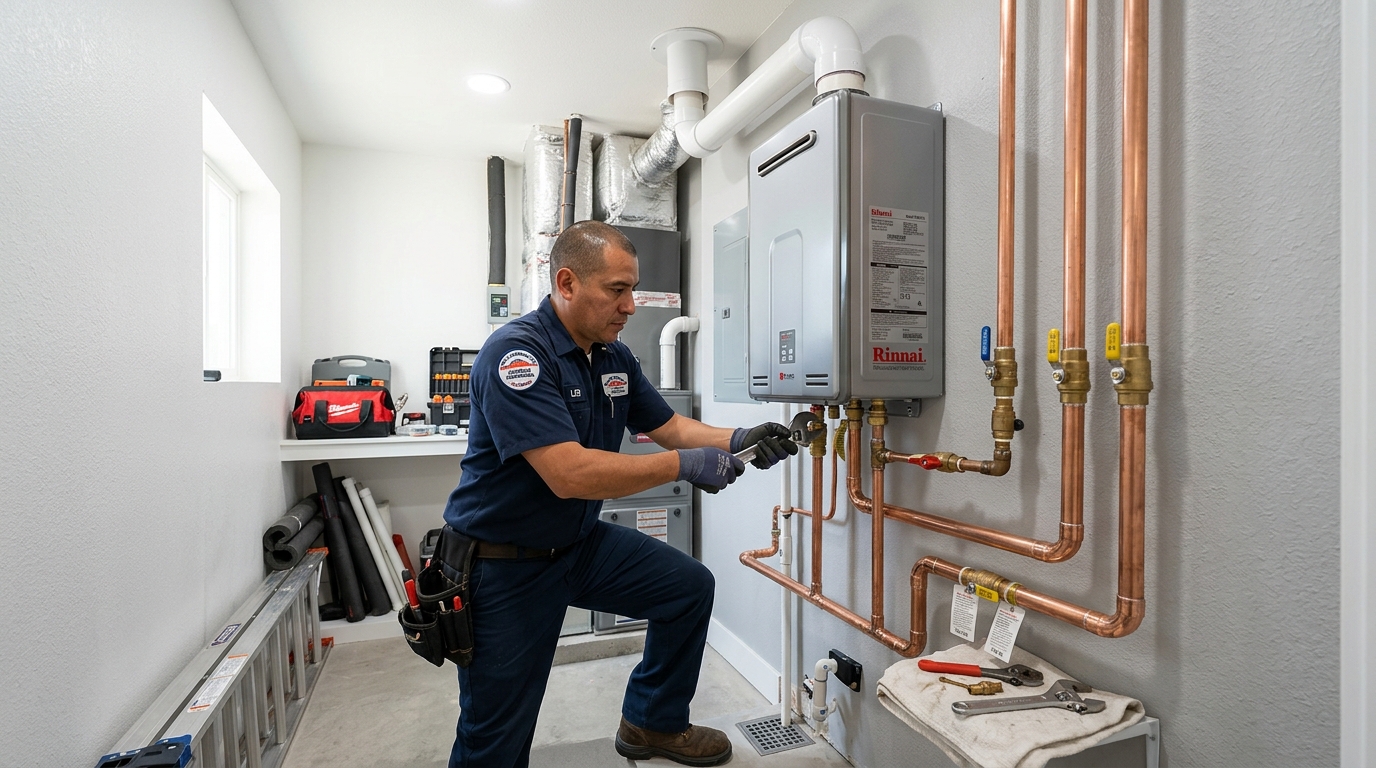
Understanding Tankless Water Heater Installation in Brighton, CO
Converting a home to tankless water heating requires careful hydraulic and thermal engineering. Standard 50-gallon storage tanks fire at a modest 40,000 BTU per hour because they have hours to slowly heat standing water. In contrast, on-demand tankless units must flash cold water to 120°F (49°C) instantaneously, requiring gas burner inputs between 180,000 and 199,000 BTU. Sizing must account for simultaneous household fixtures and Colorado winter groundwater temperatures.
In Brighton, winter municipal water drawn from alluvial wells drops to 40°F (4°C). To achieve a comfortable 120°F (49°C) tap temperature, the tankless system must produce an 80°F (44°C) temperature rise. A unit rated for 9.5 gallons per minute (GPM) in warm southern states may only deliver 4.5 to 5.2 GPM in a Colorado winter. Our master plumbers engineer every installation to guarantee multiple simultaneous showers during sub-zero January blizzards without temperature drops.
When transitioning your household to endless hot water, our approach to water heater replacement services in Brighton ensures correct Colorado winter sizing. We evaluate total household fixture demand against local 40°F inlet water temperatures, ensuring your new unit delivers powerful hot water flow even during sub-zero January cold snaps.
Engineering & Technical Methods for Tankless Water Heater Installation
Restoring tankless water heater installation to peak factory specifications requires strict adherence to manufacturer engineering tolerances and Colorado plumbing codes. Here is the technical protocol our certified technicians follow:
Our installation protocol begins with a comprehensive gas supply load calculation according to the International Fuel Gas Code (IFGC). We verify that your gas meter capacity (rated in cubic feet per hour, CFH) and piping diameter can support 199,000 BTU alongside your central furnace. In many Brighton homes, we upsize the branch gas piping from 1/2 inch to 3/4 inch or 1 inch directly from the meter manifold to prevent burner starving.
We mount the compact condensing unit securely to basement concrete walls or interior framework using heavy-duty strut channel brackets. For ventilation, we core-drill through the exterior rim joist to install dedicated twin-pipe concentric Polypropylene (PP) or Schedule 40 PVC direct-venting terminating safely outside. We install a full-port brass isolation valve service kit, a code-compliant thermal expansion tank, and a commercial inline condensate neutralizer to prevent acidic wastewater (pH 3–5) from corroding municipal sewer pipes.
8 Warning Signs You Need Tankless Water Heater Installation Immediately
Water heating problems rarely occur without early mechanical warnings. If your Brighton home exhibits any of these 8 symptoms related to tankless water heater installation, prompt diagnostic evaluation is essential:
-
Family Frequently Running Out of Hot Water:
Your current 40- or 50-gallon tank cannot keep pace with back-to-back morning showers, dishwashers, and laundry loads.
-
Utility Room Heavily Cramped by Bulky Tank:
A massive cylindrical storage tank occupying 10 to 15 square feet of floor space that could be reclaimed with a wall-mounted unit.
-
Existing Tank Approaching 10+ Years of Age:
An aging storage tank operating on borrowed time that risks bursting and flooding finished basement areas.
-
Excessive Monthly Natural Gas Energy Bills:
Continuous standby heat loss from keeping 50 gallons hot 24 hours a day when nobody is home wasting energy.
-
Desire to Fill Large Freestanding Soaking Tubs:
Modern luxury bathtubs requiring 70+ gallons of hot water draining standard storage tanks before reaching full depth.
-
Finished Basement Remodel or Floorplan Redesign:
Moving domestic water heating to an exterior basement wall to open up square footage for bedrooms or entertainment rooms.
-
Sediment Buildup Rupturing Tanks in Your Neighborhood:
Witnessing neighbors suffer costly basement floods motivating a shift away from dangerous standing water tanks.
-
Qualifying for Substantial Utility Energy Rebates:
Taking advantage of Xcel Energy cash rebates and federal 25C tax credits for installing 0.95+ Uniform Energy Factor (UEF) equipment.
Root Causes of Tankless Water Heater Installation Issues in Brighton
Engineering a successful tankless conversion in Brighton, Colorado requires addressing distinct regional infrastructure factors:
-
Severe Colorado Winter Groundwater Delta-T:
Brighton winter groundwater drops to 40°F (4°C). An 80°F temperature rise is required to deliver 120°F water. Sizing units without accounting for this temperature delta leads to weak shower flow rates in winter.
-
High Altitude Atmospheric Combustion Derating:
At 4,984 feet elevation, atmospheric air contains 15% less oxygen. Modern condensing units like Navien NPE-240A2 adjust blower fan RPM automatically, but gas orifice pressure must be calibrated precisely.
-
Gas Pipe Sizing Limitations in Older Homes:
Older Brighton homes built in the 1970s and 1980s often feature 1/2-inch steel gas feeds sized for small 36,000 BTU tanks. These lines must be upsized to 3/4-inch to prevent fuel starvation.
-
Alluvial Mineral Hardness Requiring Pre-Treatment:
Brighton water contains 12 to 18 GPG of hardness. Installing an inline scale prevention cartridge or whole-home water softener preserves the 25-year lifespan of new copper heat exchangers.
Homeowner Pre-Installation Planning Checklist
Review these 4 practical considerations before meeting with our installation engineer:
-
Count Your Peak Simultaneous Hot Water Fixtures:
Determine how many fixtures your household runs at once (e.g., 2 showers at 2.0 GPM each + washing machine at 1.5 GPM = 5.5 GPM peak demand).
-
Locate Your Natural Gas Meter and Note the CFH Rating:
Check the metal badge on your exterior gas meter for its cubic feet per hour (CFH) rating (e.g., 250 CFH or 400 CFH) to verify gas capacity.
-
Identify an Exterior Wall Venting Path:
Examine your basement utility room to identify an exterior rim joist wall where two 2-inch or 3-inch PVC vent pipes can exit safely away from windows.
-
Check for a Nearby 120V Grounded Electrical Outlet:
Tankless gas units require a standard 120-volt grounded electrical outlet to power electronic control boards, exhaust blowers, and freeze protection solenoids.
The Professional Tankless Water Heater Installation Visit: Step-by-Step Protocol
Every tankless water heater installation service call conducted by Brighton Water Heater Pros follows a structured, 6-stage engineering and safety workflow:
-
Comprehensive In-Home Flow & Gas Audit:
Our master plumber evaluates household fixture flow rates, measures gas line distances, and inspects the electrical panel.
-
City of Brighton Permit Coordination:
We prepare and submit all mechanical and plumbing permit applications with the City of Brighton Community Development Department.
-
Safe Removal & Eco-Friendly Tank Recycling:
We drain your old storage tank, disconnect gas and water lines safely, and transport the old unit to an authorized recycling facility.
-
Precision Wall Mounting & Gas Upsizing:
We mount the condensing tankless unit to structural framing and upsize gas piping with heavy-duty black iron or CSST lines.
-
Direct Venting & Condensate Neutralization:
We core-drill exterior vent terminations with firestop collars and route acidic condensate lines through limestone neutralizer tubes.
-
System Commissioning & Homeowner Walkthrough:
We purge air, verify dynamic gas pressure, set digital water temperature to 120°F (49°C), and demonstrate basic maintenance procedures.
Cost Factors & Pricing for Tankless Water Heater Installation in Adams County
A complete tankless conversion in Brighton includes equipment, gas upsizing, venting, and municipal permits:
| Service / Component | Estimated Cost Range | Engineering Scope & Details |
|---|---|---|
| Standard Tankless Conversion (Direct Swap) | $2,800 – $4,200 | High-efficiency condensing unit (0.95 UEF), standard venting, isolation valve kit, and disposal. |
| Complex Tankless Conversion with Gas Upsizing | $3,800 – $5,500 | Includes running 3/4-inch or 1-inch gas line across basements, long venting runs, and permits. |
| Whole-House Recirculation Loop Addition | $600 – $1,200 | Installing a dedicated return line or thermal bypass bridge valves for instant hot water at every tap. |
| Inline Scale Guard / Pre-Treatment System | $350 – $650 | Installing polyphosphate anti-scale media filters on incoming cold water lines to block mineral scale. |
| City of Brighton Permit & Inspection Fees | $120 – $200 | Official municipal plan review, building permit, and master plumber code sign-off inspection. |
When Does Tankless Water Heater Installation Become an Urgent Plumbing Emergency?
Call our Brighton heating replacement desk at +1 303-207-3323 if your current hot water tank has failed completely:
- Same-day removal of ruptured storage tanks and flood containment.
- Fully stocked installation vans carrying Navien and Rinnai condensing units.
- Temporary hot water solutions while venting and gas upsizing are completed.
- Expedited emergency municipal permit filing with Adams County.
Frequently Asked Questions About Tankless Water Heater Installation
Will my existing natural gas line support a new tankless water heater?
Standard storage tanks draw 40,000 BTU, while high-efficiency tankless units require 180,000 to 199,000 BTU. In most cases, we upsize branch piping from 1/2-inch to 3/4-inch to guarantee sufficient fuel volume.
How does Brighton's cold winter groundwater affect tankless water output?
Winter groundwater in Brighton drops to 40°F (4°C). Reaching 120°F requires an 80°F temperature rise. We size units based on this realistic winter temperature delta so your showers remain hot in January.
Where can a tankless water heater be mounted in my Brighton home?
Tankless units mount compactly on interior framing or exterior basement walls, venting directly outdoors through 2-inch or 3-inch PVC or polypropylene pipes without needing a chimney.
What is the expected lifespan of a properly maintained tankless heater?
High-efficiency condensing tankless water heaters last 20 to 25 years with annual mineral descaling—more than double the lifespan of traditional storage tanks.
Are building permits required for tankless installation in Brighton, CO?
Yes, the City of Brighton Community Development Department requires plumbing and mechanical permits to verify gas line sizing, combustion safety, and venting compliance.
Can I pair a whole-home water softener with my new tankless water heater?
Yes, pairing a water softener with a tankless heater prevents mineral scale accumulation completely, preserving peak heating efficiency and extending equipment life.
Tankless Water Heater Installation Service Coverage Across All Brighton Neighborhoods
Our licensed installation plumbers install high-efficiency tankless water heaters across all Brighton neighborhoods and surrounding communities, including Brighton Crossings, Bromley Park, Brighton East Farms, Platte River Ranch, Silver Peaks, Historic Downtown Brighton, Farmlore, Todd Creek, Lochbuie, and Henderson.