
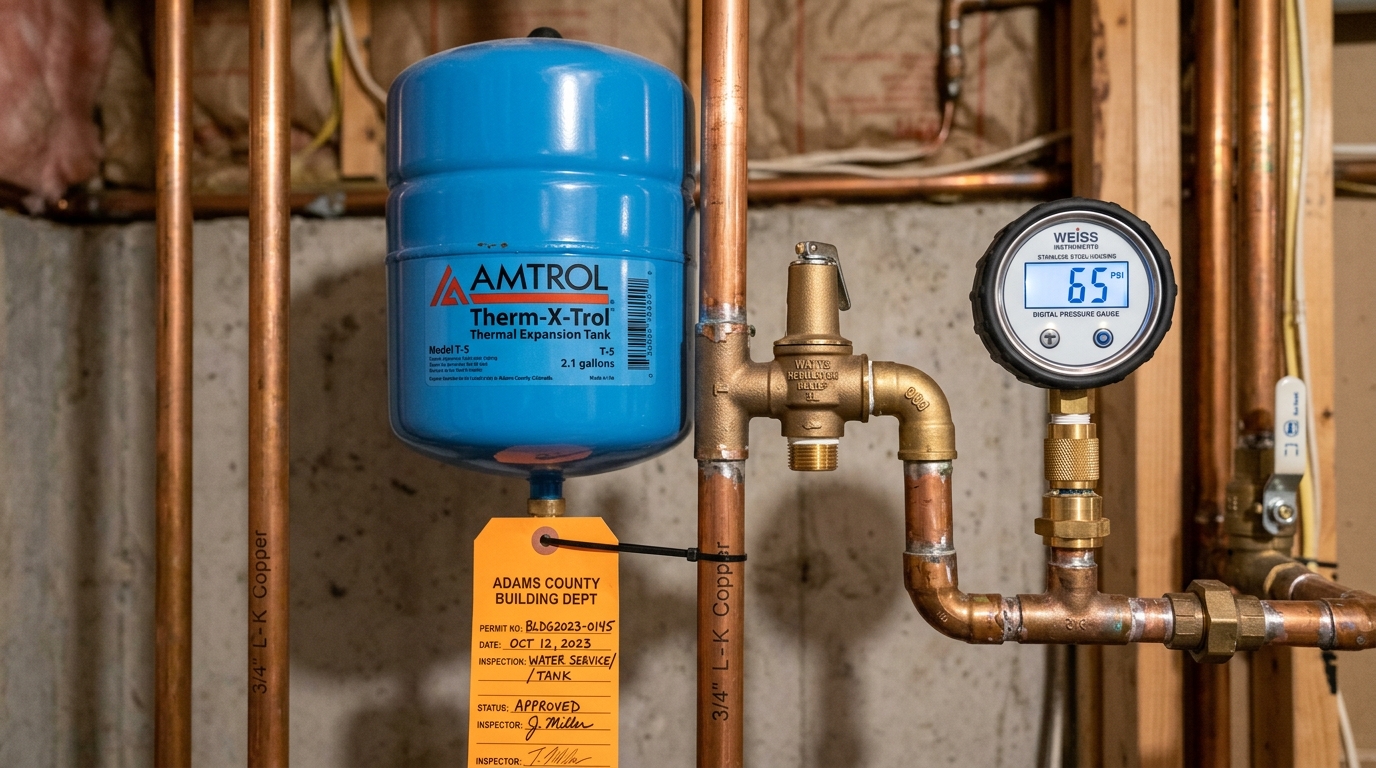
Understanding Thermal Expansion Tank Installation in Brighton, CO
The fundamental laws of hydraulic physics dictate that water is virtually incompressible. When water heats from its cold municipal delivery temperature of 45°F (7°C) up to standard household storage temperature of 125°F (52°C), its molecular volume expands by roughly 2.5 percent. In an older open plumbing system, this expanding water pushed backward into the city water main. However, modern Brighton municipal water meters and residential service lines are fitted with backflow check valves and pressure reducing valves to protect the municipal supply. These valves act as one-way gates, creating a closed-loop system where expanding water has zero escape path.
As the water heater cycles in a closed system, thermal expansion forces line pressure to spike from a normal static level of 60 PSI (414 kPa) up to 130 to 150 PSI (896 to 1034 kPa). This extreme hydrostatic pressure flexes the inner steel water heater tank welds, cracks the vitreous porcelain enamel glass lining, ruptures internal washing machine and dishwasher solenoid valves, causes toilets to phantom-flush, and forces the temperature and pressure (T&P) safety valve to continuously discharge scalding water onto the floor. Installing an ASME-approved thermal expansion tank provides a pressurized air cushion that harmlessly absorbs expanding volume, keeping household pressure below 75 PSI.
When protecting closed-loop residential plumbing systems from high-pressure surges, our approach to Brighton water heater services guarantees full code compliance. We test home static water pressure, pre-charge expansion bladders accurately, and prevent hydrostatic spikes from rupturing tank seams.
Engineering & Technical Methods for Thermal Expansion Tank Installation
Restoring thermal expansion tank installation to peak factory specifications requires strict adherence to manufacturer engineering tolerances and Colorado plumbing codes. Here is the technical protocol our certified technicians follow:
Our installation and diagnostic methodology begins with measuring static line pressure at an outdoor hose bib or laundry utility connection using a calibrated oil-damped test gauge with an integrated maximum-pressure lazy hand. We test pressure across a complete water heating recovery cycle to document hydrostatic expansion spikes. To assess an existing expansion tank, we test the top Schrader valve using a digital tire pressure gauge. If water discharges from the air valve, the internal butyl rubber bladder has ruptured, and the steel canister is completely waterlogged and useless.
When installing or replacing an expansion tank, our plumbers install an independent brass isolation ball valve and a heavy-duty brass tee fitting on the cold water supply line between the shutoff valve and the water heater tank inlet. We calculate tank volume requirements based on total water heater storage capacity, maximum recovery temperature, and incoming static supply pressure (installing 2.0-gallon tanks like the Amtrol Therm-X-Trol ST-5 for up to 50-gallon heaters, or 4.4-gallon ST-12 tanks for 75-gallon systems). Crucially, before opening water valves, we pre-charge the tank's air bladder with a digital hand pump to match your home's exact static water pressure.
8 Warning Signs You Need Thermal Expansion Tank Installation Immediately
Water heating problems rarely occur without early mechanical warnings. If your Brighton home exhibits any of these 8 symptoms related to thermal expansion tank installation, prompt diagnostic evaluation is essential:
-
T&P Safety Relief Valve Constantly Weeping or Dripping:
Excessive hydrostatic thermal pressure exceeding 150 PSI forcing the safety relief valve spring open during heating cycles.
-
Water Discharges from the Expansion Tank Schrader Valve:
Depressing the top air valve releases water instead of air, proving the internal flexible rubber diaphragm has torn completely.
-
Thermal Expansion Tank Feels Extremely Heavy and Cold:
The entire canister has filled with water rather than maintaining its pre-charged compressed air cushion.
-
Faucets Spitting High-Velocity Bursts When First Opened:
Pressurized water and trapped micro-bubbles blasting out of kitchen and bathroom faucets after long recovery cycles.
-
Toilets Running Continuously or Phantom Flushing:
Hydrostatic pressure spikes pushing past the rubber flapper or toilet fill valve seal into the bowl.
-
Washing Machine and Dishwasher Solenoid Valves Leaking:
Appliance water inlet solenoids designed for 80 PSI experiencing valve seal rupture under 130+ PSI thermal surges.
-
Pipes Banging and Clattering in Walls (Water Hammer):
Thermal expansion magnifying hydraulic shockwaves whenever quick-closing appliance valves shut down.
-
City of Brighton Building Inspector Flags Missing Tank:
Water heater failing municipal permit inspection due to lack of a code-mandated thermal expansion tank.
Root Causes of Thermal Expansion Tank Installation Issues in Brighton
Thermal expansion tank failures and high-pressure stress in Brighton, Colorado stem from specific municipal infrastructure and plumbing characteristics:
-
Universal Municipal Closed-Loop Meter Retrofits:
The City of Brighton Utilities department equips water meters with dual check backflow preventers to protect the public drinking supply. This traps expanding heated water entirely inside the residential home.
-
High Municipal Static Water Main Pressures Along I-76:
Neighborhoods along the Highway 85 and I-76 corridors experience baseline municipal water pressures exceeding 80 to 90 PSI. Without a functioning PRV and matched expansion tank, thermal expansion spikes exceed 150 PSI.
-
Hard Water Mineral Scaling of Expansion Tank Nipple:
Brighton tap water contains 12 to 18 grains per gallon of mineral hardness. Calcium scale encrusts the narrow 3/4-inch threaded brass expansion tank connection port, blocking water from reaching the bladder.
-
Improper Initial Air Pre-Charge During Installation:
Many unlicensed handymen install expansion tanks straight out of the box with the factory 40 PSI pre-charge. If home static pressure is 65 PSI, the bladder remains permanently flattened and fails prematurely.
Safe Homeowner Thermal Expansion Checks
Perform these 4 safe diagnostic checks to evaluate your home's thermal expansion tank condition:
-
Perform the Tap Test on the Tank Body:
Gently tap the top third and bottom third of the small blue or beige tank with a coin. The top should sound hollow (air), and the bottom should sound solid (water). If the entire tank sounds solid, it is waterlogged.
-
Test the Top Air Schrader Valve:
Unscrew the plastic valve cap on top of the expansion tank. Lightly depress the small center brass stem with a thumbnail. If ANY water squirts out, the bladder has ruptured and the tank must be replaced.
-
Inspect the Temperature and Pressure Discharge Pipe:
Examine the copper or CPVC discharge tube extending from the side of your water heater down toward the floor. If water puddles beneath this pipe during heating cycles, system pressure is exceeding 150 PSI.
-
Verify Your Home Static Water Pressure:
Thread a simple 0-100 PSI pressure gauge onto an exterior hose bib or laundry faucet with no fixtures running. If static pressure exceeds 75 PSI, your pressure reducing valve (PRV) may also be failing.
The Professional Thermal Expansion Tank Installation Visit: Step-by-Step Protocol
Every thermal expansion tank installation service call conducted by Brighton Water Heater Pros follows a structured, 6-stage engineering and safety workflow:
-
Static & Thermal Hydrostatic Pressure Audit:
Plumbers connect oil-damped test gauges with high-pressure lazy hands to record baseline street pressure and peak thermal expansion pressure spikes.
-
Schrader Bladder Pneumatic Testing:
We isolate the expansion tank, relieve water pressure, and test internal air pressure with calibrated digital tire gauges to verify bladder elasticity.
-
Sizing Calculation for Water Heater & Supply Volume:
We calculate required acceptance volume based on tank gallon capacity, maximum BTU or watt input, and incoming line pressure to select the proper ASME vessel size.
-
Brass Isolation Valve & Quick-Disconnect Installation:
We install full-port brass isolation ball valves and union tees, allowing future expansion tank servicing without shutting down the entire home's water supply.
-
Precise Digital Pneumatic Pre-Charging:
Using oil-free compressed air, we inflate the tank bladder to exactly match the home's regulated static incoming water pressure before exposing it to water.
-
Thermal Cycle Run & Valve Seal Verification:
We fire the water heater, monitor pressure rise through a complete 30-minute recovery cycle, and inspect all soldered and threaded connections.
Cost Factors & Pricing for Thermal Expansion Tank Installation in Adams County
Thermal expansion tank installation and replacement pricing in Brighton varies based on tank gallon capacity, mounting hardware, and required code upgrades:
| Service / Component | Estimated Cost Range | Engineering Scope & Details |
|---|---|---|
| Diagnostic Pressure Audit & Bladder Testing | $125 – $175 | Testing baseline static pressure, peak thermal expansion rise, and expansion tank air pressure. |
| Standard 2.0-Gallon Expansion Tank Replacement | $250 – $395 | Replacing failed 2-gal tank (Amtrol ST-5) on standard 40- or 50-gallon water heaters with proper air pre-charge. |
| High-Capacity 4.4-Gallon Expansion Tank Installation | $345 – $495 | Installing upgraded 4.4-gal tank (Amtrol ST-12) for large 75-gallon water heaters or systems with static pressure over 70 PSI. |
| New Expansion Tank Addition to Non-Compliant Line | $325 – $525 | Cutting cold water copper supply pipe, soldering new brass tee, and mounting code-compliant expansion tank. |
| Support Bracket & Wall-Mounting Reinforcement | $125 – $195 | Installing heavy-duty galvanized seismic steel brackets to support water-filled expansion tanks and prevent pipe stress. |
| Combo Expansion Tank & Pressure Reducing Valve (PRV) | $550 – $850 | Replacing failed main water line PRV and installing new pre-charged thermal expansion tank for complete closed-loop protection. |
When Does Thermal Expansion Tank Installation Become an Urgent Plumbing Emergency?
Call our Brighton closed-loop pressure emergency desk at +1 303-207-3323 immediately if you encounter:
- Boiling water and high-pressure steam blasting continuously from the T&P relief valve discharge line.
- Water spraying under high pressure from cracked copper joints or ruptured expansion tank fittings.
- Water heater tank seams creaking, bowing, or bulging visibly under extreme internal pressure.
- Complete failure of multiple plumbing fixture hoses or washing machine supply lines simultaneously.
Frequently Asked Questions About Thermal Expansion Tank Installation
Why does the City of Brighton mandate thermal expansion tanks?
City of Brighton municipal building codes and the International Plumbing Code (IPC 607.3) require thermal expansion tanks on all closed-loop water heating systems. Because modern water meters and pressure reducing valves prevent expanding water from pushing back into the street, an expansion tank is required to absorb thermal pressure surges and protect plumbing from rupturing.
What happens if my water heater does not have an expansion tank?
Without an expansion tank on a closed-loop system, water pressure surges from 60 PSI to over 130 PSI every time the water heater fires. This extreme pressure stretches and cracks the internal glass lining of the water heater, tears tank welds, ruins washing machine solenoid valves, causes faucets to drip, and voids manufacturer tank warranties.
How long does a thermal expansion tank last in Brighton?
A quality thermal expansion tank typically lasts 5 to 7 years in Brighton. The continuous expansion and contraction cycles of the internal rubber bladder, combined with municipal pressure variations, eventually cause the bladder material to fatigue and tear.
How do I know what size expansion tank my water heater needs?
Expansion tank sizing depends on water heater gallon capacity and incoming static water pressure. For standard 40- and 50-gallon tanks with water pressure below 65 PSI, a 2.0-gallon expansion tank (such as Amtrol ST-5) is standard. For 75-gallon tanks or pressures exceeding 70 PSI, an upgraded 4.4-gallon tank (Amtrol ST-12) is required.
Can a thermal expansion tank be installed horizontally?
While some manufacturers allow horizontal installation if properly supported, vertical mounting with the water connection at the bottom or top is strongly preferred. Horizontal orientation places heavy cantilever stress on the copper pipe as the tank fills with water and can cause premature bladder wear.
What pressure should the expansion tank air bladder be set to?
The expansion tank air bladder must be pre-charged to exactly match the home's incoming static water pressure (typically 55 to 65 PSI in Brighton). Installing a tank with factory 40 PSI air pressure on a 65 PSI system leaves the bladder compressed and reduces its effective expansion volume.
Thermal Expansion Tank Installation Service Coverage Across All Brighton Neighborhoods
We provide code-compliant thermal expansion tank installation, pressure testing, and PRV calibration across all Brighton neighborhoods and surrounding communities, including Brighton Crossings, Bromley Park, Brighton East Farms, Platte River Ranch, Silver Peaks, Historic Downtown Brighton, Farmlore, Todd Creek, Lochbuie, and Henderson.