
Understanding Thermostat & Heating Element Repair in Brighton, CO
Inside a residential electric water heater, water is heated by two electric immersion elements controlled by an upper and lower thermostat operating on a dedicated 240-volt, 30-amp circuit. These elements operate in a non-simultaneous interlocking sequence: they never fire at the exact same time, which prevents electrical overload on your home's electrical panel. When the tank fills with cold water, the upper thermostat prioritizes heating the top 20 gallons first. Once the upper water satisfies the thermostat setting (typically 120°F / 49°C), the upper thermostat flips an internal mechanical switch, transferring 240V current down to the lower thermostat and element to heat the remaining water.
In Brighton, municipal tap water carries 12 to 18 grains per gallon of dissolved calcium carbonate and magnesium. Because electric immersion elements reach operating surface temperatures exceeding 300°F (149°C), mineral crystals precipitate directly onto the hot metal sheaths. Over 24 to 36 months, a dense limestone blanket encases the lower heating element. This scale acts as a heavy thermal insulator, preventing water from cooling the element. Internal temperatures inside the Nichrome resistance wire soar past 1,200°F (649°C) until the alloy wire melts and breaks the circuit. Our technicians carry digital multimeters and heavy-duty Incoloy 800 nickel-alloy elements that resist hard water scale.
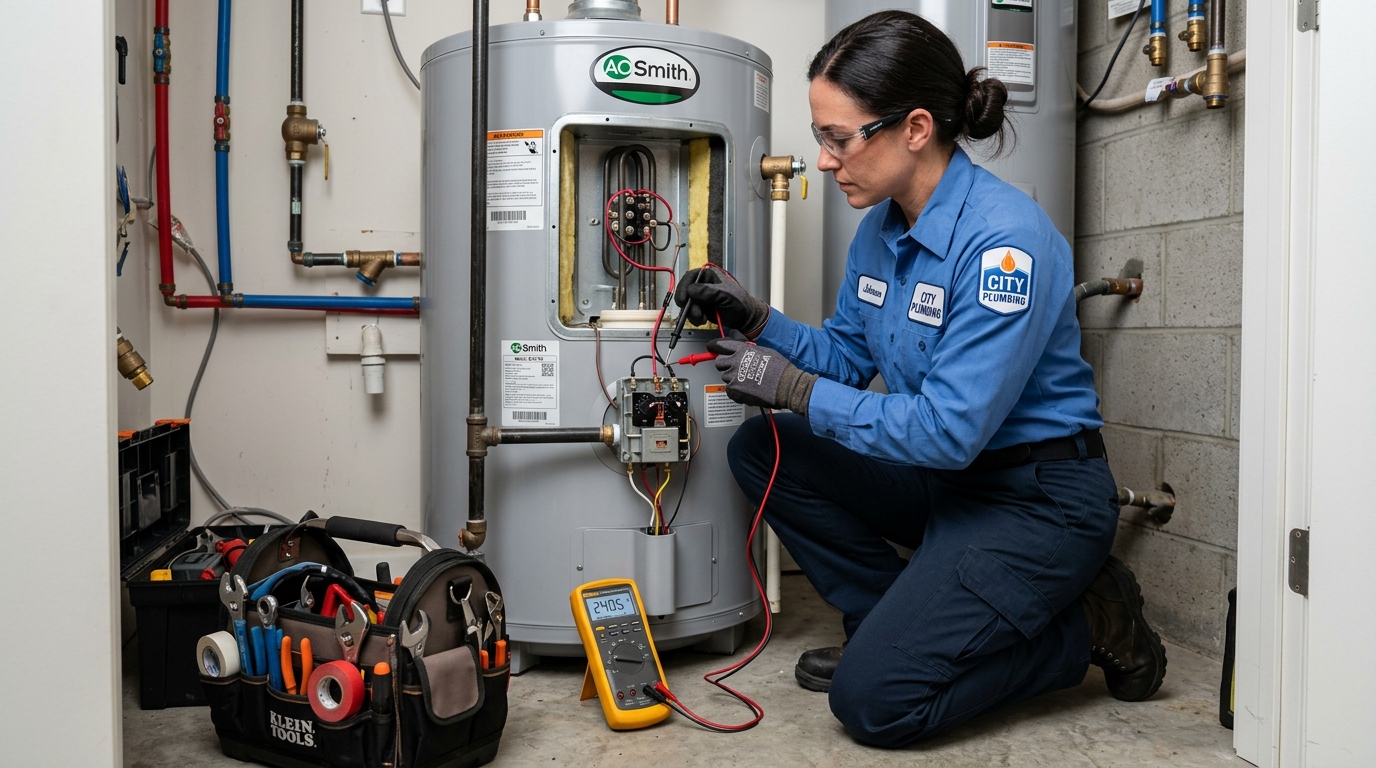
When repairing failed electric water heater heating circuits, our approach to local Brighton water heater experts uses digital multimeter precision. We test non-simultaneous interlocking thermostat logic, calculate exact element resistance, and prevent dry-fire element destruction.
Engineering & Technical Methods for Thermostat & Heating Element Repair
Restoring thermostat & heating element repair to peak factory specifications requires strict adherence to manufacturer engineering tolerances and Colorado plumbing codes. Here is the technical protocol our certified technicians follow:
Our electric component diagnostic protocol starts with electrical lockout/tagout at the main service panel, followed by verifying zero voltage at the water heater junction box using certified non-contact voltage testers. We remove both upper and lower access panel covers, pull back protective fiberglass insulation, and visually inspect terminal screws and high-temperature wiring for scorch marks, melted wire nuts, or corroded plastic terminal housings. Scorched wiring indicates high electrical resistance caused by loose connections.
Using calibrated digital multimeters, we execute strict diagnostic testing: with power energized under demand, we measure voltage across upper and lower thermostat terminals (confirming 240V across terminal screws). With power turned completely off and element wires disconnected, we measure electrical resistance across element screws. Under Ohm's Law (Resistance = Voltage squared divided by Wattage, or 240² / 4500 = 12.8 ohms), a healthy 4,500-watt element reads between 11.5 and 14.5 ohms. A reading of infinity (OL) confirms a burnt open coil, while a reading to ground confirms a split outer sheath. We remove seized elements with 1-1/2-inch deep-well sockets, clean internal threads, and install low-watt-density foldback Incoloy elements.
8 Warning Signs You Need Thermostat & Heating Element Repair Immediately
Water heating problems rarely occur without early mechanical warnings. If your Brighton home exhibits any of these 8 symptoms related to thermostat & heating element repair, prompt diagnostic evaluation is essential:
-
Water is Warm for 3 Minutes Then Turns Ice Cold:
The lower heating element has burned out, leaving only the top 15 to 20 gallons of water heated by the upper element.
-
Water is Completely Cold from Every Faucet in the Home:
The upper thermostat has failed, the upper heating element has burned open, or the 240V circuit breaker has tripped.
-
Red ECO Emergency Reset Button Pops Out Repeatedly:
The high-limit Emergency Cut-Off (ECO) switch trips at 170°F because thermostat contacts are welded shut or an element is shorted to ground.
-
Dedicated 240V Double-Pole Breaker Trips Instantly:
A ruptured heating element metal sheath allowing 240-volt electric current to dead-short directly into the water.
-
Water Temperature is Dangerously Scalding Hot:
Upper or lower thermostat mechanical contact points welded together in the closed position, heating water continuously past 150°F.
-
Loud Hissing, Sizzling, or Buzzing Noise from Tank Interior:
Dense mineral scale blanket encasing the heating elements, boiling trapped micro-steam pockets against the metal sheath.
-
Scorched Plastic Odor Near the Upper Access Panel:
Loose terminal screw connections generating high electrical resistance that melts terminal blocks and wire insulation.
-
Water Weeping Around Element Hex Mounting Flange:
Rubber element gasket degraded by heat cycles or dissolved by minerals, allowing slow water seepage into the electrical bay.
Root Causes of Thermostat & Heating Element Repair Issues in Brighton
Heating element and thermostat failures in Brighton, Colorado stem from distinct chemical and electrical factors:
-
Severe Calcium Carbonate Scale Encasing Lower Elements:
Brighton water contains 12 to 18 GPG of dissolved minerals. Calcium encrusts lower heating elements with up to an inch of rock scale, insulating the metal and melting the internal resistance wire within 2 to 4 years.
-
Thermal Contact Welding from Extended Winter Cycles:
Front Range winter groundwater drops below 42°F. Heating 50 gallons requires long, continuous firing cycles that arc and weld mechanical thermostat contacts shut, overheating the vessel.
-
Dry Firing During Tank Draining or Maintenance:
Restoring electrical power to an electric water heater before the vessel is 100% full of water vaporizes a standard copper heating element in less than 30 seconds.
-
Galvanic Corrosion at Threaded Tank Flange Bushings:
Dissimilar metals between standard copper element sheaths and steel tank spuds spark galvanic oxidation, seizing element threads and destroying rubber O-ring seals.
Safe Homeowner Electric Water Heater Troubleshooting
Perform these 4 safe preliminary checks if your electric water heater stops heating:
-
Check Your Main Electrical Panel Breaker:
Locate the dedicated double-pole 240V, 30-amp breaker labeled 'Water Heater.' If it has tripped to the center position, firmly switch it fully 'OFF' and then back 'ON.' If it trips again immediately, do not reset it; call our licensed technicians.
-
Reset the Red High-Limit ECO Button Once:
Turn off the 240V breaker first. Remove the upper access panel screws and fold back the fiberglass insulation. Press the red reset button firmly until you hear a sharp mechanical click. Replace insulation and cover before turning power on. If it trips again, an electrical fault exists.
-
Inspect for Water Weeping Behind Panel Covers:
With power off, inspect the electrical compartment for droplets of water or rust weeping from the round element mounting flange. Water in the electrical cavity creates dangerous short circuits.
-
Verify Thermostat Temperature Setting:
Ensure both upper and lower thermostat dials are calibrated to the recommended 120°F (49°C) mark. Setting dials above 130°F accelerates mineral scale accumulation and increases scalding hazard.
The Professional Thermostat & Heating Element Repair Visit: Step-by-Step Protocol
Every thermostat & heating element repair service call conducted by Brighton Water Heater Pros follows a structured, 6-stage engineering and safety workflow:
-
Lockout/Tagout & 240V Electrical Safety Audit:
Plumbers isolate the circuit breaker, verify zero voltage with non-contact testers, and verify ground conductor integrity at the junction box.
-
Visual Terminal & Insulation Degradation Check:
We inspect wiring for heat degradation, arcing carbon tracks, and oxidized screw terminals that increase circuit resistance.
-
Thermostat Continuity & Interlocking Voltage Diagnostics:
Using digital multimeters, we test 240V switching between upper and lower thermostats across active heating demand cycles.
-
Element Resistance & Ground-Fault Ohm Testing:
We disconnect element lead wires and measure electrical resistance across terminals (targeting 12.8 ohms) and from terminals to the steel tank wall (verifying infinite resistance to ground).
-
Seized Element Extraction & Spud Thread Chasing:
We drain the tank below element level, break loose seized element hex flanges using heavy-duty 1-1/2-inch sockets and breaker bars, and chase internal tank threads.
-
Incoloy Element Installation & Dry-Fire Safety Purge:
We install new low-watt-density Incoloy 800 foldback elements with new gaskets, fill the vessel completely, purge air from hot taps, and test amp draw under load.
Cost Factors & Pricing for Thermostat & Heating Element Repair in Adams County
Thermostat and heating element replacement costs in Brighton depend on the component failed, alloy grade, and electrical condition:
| Service / Component | Estimated Cost Range | Engineering Scope & Details |
|---|---|---|
| Electrical Diagnostic & Multimeter Circuit Audit | $125 – $175 | Complete 240V voltage, element ohm resistance, thermostat switching, and ground fault safety testing. |
| Single Incoloy Heating Element Replacement | $195 – $295 | Replacing burnt upper or lower element with premium scale-resistant Incoloy 800 element, gasket, and fill purge. |
| Complete Dual Element Replacement (Upper & Lower) | $295 – $425 | Replacing both heating elements simultaneously with low-watt-density foldback elements and tank flushing. |
| Thermostat Replacement (Upper or Lower) | $195 – $285 | Installing and calibrating new OEM Apcom or Therm-O-Disc thermostat with high-limit ECO reset. |
| Complete Electrical Restoration (Dual Elements & Thermostats) | $395 – $575 | Replacing both heating elements and both upper/lower thermostats for a complete electrical overhaul. |
| Electrical Wiring Assembly & Junction Box Repair | $175 – $325 | Replacing heat-damaged 10 AWG copper conductors, melted terminal blocks, and scorched wire nuts. |
When Does Thermostat & Heating Element Repair Become an Urgent Plumbing Emergency?
Call our 240V electric heating element diagnostic team at +1 303-207-3323 immediately if you encounter:
- Active electrical arcing, buzzing sparks, or acrid burning plastic smells from water heater access panels.
- Water spraying or dripping directly onto exposed 240V electrical wiring and thermostat terminals.
- Water boiling furiously inside the tank and blasting steam from the T&P relief valve pipe.
- The 240-volt double-pole breaker violently tripping with a loud pop every time power is restored.
Frequently Asked Questions About Thermostat & Heating Element Repair
Why is my hot water running out after only 3 to 5 minutes?
When hot water runs out in just a few minutes, the lower heating element has almost certainly burned out. In an electric water heater, the upper element heats only the top 15 to 20 gallons of water. Once that small volume is exhausted, incoming cold water cannot be heated because the lower element is dead.
What causes electric water heater elements to burn out so quickly in Brighton?
Brighton tap water contains 12 to 18 grains per gallon of mineral hardness. As immersion elements heat up, calcium carbonate crusts around the element sheath. This thick scale layer insulates the element, preventing water from cooling it. Internal temperatures exceed 1,200°F until the Nichrome resistance wire melts.
What is an Incoloy heating element and why is it recommended?
Standard heating elements are made of copper tubing with a thin coating. Incoloy elements are manufactured from a high-nickel, high-chromium stainless alloy designed for extreme chemical and thermal resistance. Incoloy elements resist mineral scale accumulation and dry-fire damage, lasting up to three times longer in Brighton's hard water.
Why does my electric water heater keep tripping the red reset button?
The red button on the upper thermostat is the Emergency Cut-Off (ECO) high-limit safety switch, which trips at 170°F. Common causes include a thermostat whose contacts have welded shut (heating water continuously), an element that has split and grounded out, or extreme mineral scale trapping heat around the thermostat sensor.
Should I replace both heating elements at the same time?
Yes. If one heating element has failed due to age and hard water scale, the companion element has endured identical operating hours and mineral exposure. Replacing both elements and both thermostats simultaneously restores the unit to factory reliability and saves the cost of a second service call.
What does 'dry firing' an electric water heater mean?
Dry firing occurs when electrical power is restored to an electric water heater before the storage vessel is completely full of water. Without water to absorb the intense thermal energy, a 4,500-watt heating element reaches cherry-red temperatures and vaporizes its internal coil within 30 seconds.
Thermostat & Heating Element Repair Service Coverage Across All Brighton Neighborhoods
We provide certified 240V electric water heater diagnostics, element replacements, and thermostat repairs across all Brighton neighborhoods and surrounding communities, including Brighton Crossings, Bromley Park, Brighton East Farms, Platte River Ranch, Silver Peaks, Historic Downtown Brighton, Farmlore, Todd Creek, Lochbuie, and Henderson.