
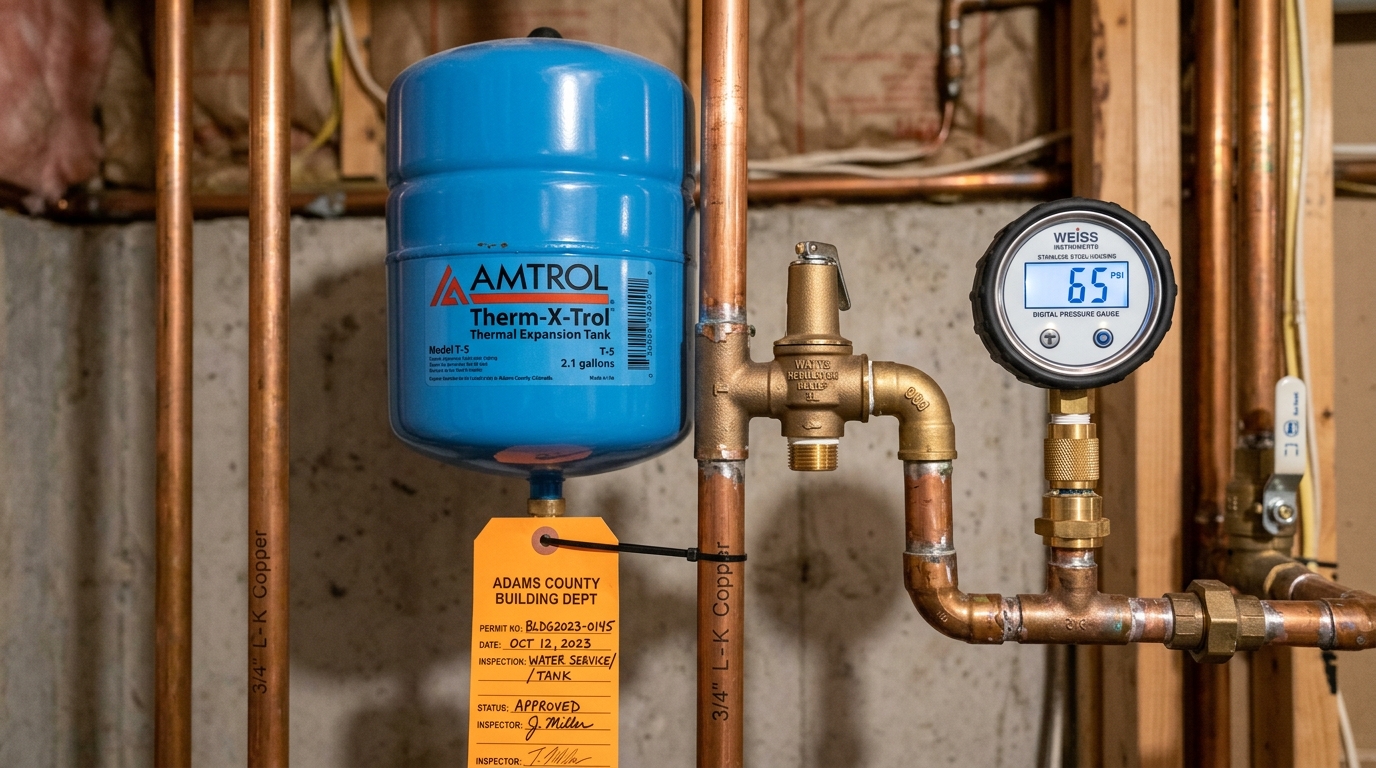
The Closed-Loop Plumbing Reality in Brighton
In older residential plumbing networks, municipal water distribution functioned as an "open system." If water inside a home's water heater expanded during heating, the excess volume simply pushed back out through the water meter into the municipal main line without increasing domestic pressure.
However, modern municipal health and water protection standards across Adams County have converted virtually all residential systems into closed loops. Two primary code-mandated devices create this closed boundary:
- Pressure Reducing Valves (PRVs): Installed where the municipal main enters your basement to knock down high street pressures (often 90 to 120 PSI) to a safe domestic level (typically 55 to 65 PSI). PRVs contain an internal one-way check valve that prevents water from flowing backwards into the street.
- Backflow Preventers and Dual Check Meters: Municipal water meters installed by the City of Brighton Utility Department incorporate backflow prevention assemblies to protect the public drinking water supply from cross-contamination.
Once a check valve or PRV is present, water that enters your home cannot leave. You now have a sealed, closed hydraulic system.
Thermal Expansion: The Incompressible Physics of Water
Water is a nearly incompressible fluid. When 50 gallons of cold municipal water at 40°F are heated up to 120°F inside your water heater, the physical volume of that water expands by roughly 1.5 to 2 quarts.
In an open system, two quarts of water easily back up into the street. But in a closed system with all faucets closed, that expanding volume has nowhere to expand. As thermal energy forces the water molecules apart against the rigid copper pipes and steel tank walls, hydrostatic pressure skyrockets exponentially.
Within 45 minutes of a recovery cycle, static water pressure inside an Adams County home can spike from a normal 60 PSI to well over 140 PSI. This continuous thermal pressure cycling causes severe mechanical damage:
1. Continuous Dripping from the T&P Relief Valve: The temperature and pressure (T&P) valve on your water heater is calibrated to open at 150 PSI or 210°F as an emergency blow-off to prevent explosion. Repeated pressure spikes cause the valve to weep, deposit calcium on its seat, and eventually fail to seal.
2. Stress Fractures in Tank Welds and Glass Lining: Standard residential water heater tanks are tested to 300 PSI but rated for a maximum working pressure of 150 PSI. Daily pressure hammering between 60 and 140 PSI repeatedly balloons the cylindrical steel shell, fracturing the brittle interior porcelain enamel and causing early seam ruptures.
3. Damage to Fixtures and Appliances: Excessive hydrostatic pressure bursts toilet fill valves, blows out washing machine solenoid valves, causes faucets to spit violently when turned on, and creates loud hydraulic water hammer banging inside walls.
Adams County & International Plumbing Code Requirements
Section 607.3 of the International Plumbing Code (IPC), as formally adopted with local amendments by the City of Brighton Community Development Department, explicitly states:
"Where a backflow preventer, check valve, or pressure reducing valve is installed on a water supply system, a device for controlling pressure caused by thermal expansion shall be provided... Such device shall be an expansion tank or other approved device sized in accordance with manufacturer instructions."
When replacing a water heater in Brighton, local code requires pulling a plumbing permit and having a city inspector verify the installation. If a thermal expansion tank is missing, improperly sized, or not pre-charged to match incoming street pressure, the installation will immediately fail municipal inspection. In addition, major manufacturers (including Bradford White, Rheem, and A.O. Smith) will void the standard 6- or 10-year tank warranty if tank seam rupture results from thermal expansion on a closed system without a functioning expansion tank.
How to Test If Your Expansion Tank Has Failed
A thermal expansion tank consists of a heavy steel shell divided into two sealed chambers by a flexible, heavy-duty butyl rubber diaphragm. The lower chamber connects directly to your domestic water pipe, while the upper chamber contains pressurized air. When water expands, it gently pushes against the rubber diaphragm, compressing the air cushion harmlessly without raising overall system pressure.
However, the rubber diaphragm constantly flexes during every shower and dishwasher cycle. Quality expansion tanks typically last 5 to 7 years in Brighton. Here is how any homeowner can check expansion tank health in two minutes:
The Tap Test: Gently tap the steel tank shell with a coin or wrench. The top portion (air side) should emit a hollow, metallic ring. The bottom portion (water side) should emit a dull, solid thud. If the entire tank sounds solid from top to bottom, the internal rubber bladder has torn, filling the entire vessel with water and rendering it useless.
The Schrader Valve Test: At the top of the tank sits a standard automotive-style tire valve (Schrader valve) beneath a protective plastic cap. Using your fingernail or a small screwdriver, briefly depress the central valve stem pin:
- If a brief burst of dry, clean air hisses out, the bladder remains intact.
- If even a single drop of water squirts out, the rubber bladder is ruptured and the tank must be replaced immediately.
Air Charge Calibration: If replacing or checking an expansion tank, the air pressure must be measured with an accurate tire gauge while the tank is depressurized (cold water supply shut off and a hot faucet opened). The air charge must be adjusted with a hand pump to match your home's incoming water pressure (usually 55 to 65 PSI). Installing a tank straight out of the box at factory pre-charge (typically 40 PSI) without calibrating it to your home's actual pressure dramatically reduces its operational effectiveness.
Frequently Asked Questions
Can an expansion tank be installed horizontally in a tight mechanical room?
While vertical orientation with the water connection at the bottom is preferred to prevent sediment collection on the diaphragm, code allows horizontal or inverted vertical mounting provided the tank is structurally supported with pipe hangers so its waterlogged weight doesn't strain the plumbing lines.
Why is my T&P relief valve still dripping after installing an expansion tank?
If your expansion tank is functional, a dripping T&P valve typically indicates your municipal Pressure Reducing Valve (PRV) has failed, allowing continuous street pressures over 85 PSI, or calcium sediment has crusted beneath the T&P valve's internal rubber sealing disc.
What size thermal expansion tank do I need for my Brighton home?
For standard 40- to 50-gallon water heaters with incoming water pressure up to 60 PSI, a 2.0-gallon expansion tank (such as Amtrol Therm-X-Trol ST-5) is standard. For 75-gallon tanks or pressures exceeding 70 PSI, an upgraded 4.4-gallon expansion tank (ST-12) is required by plumbing code.