
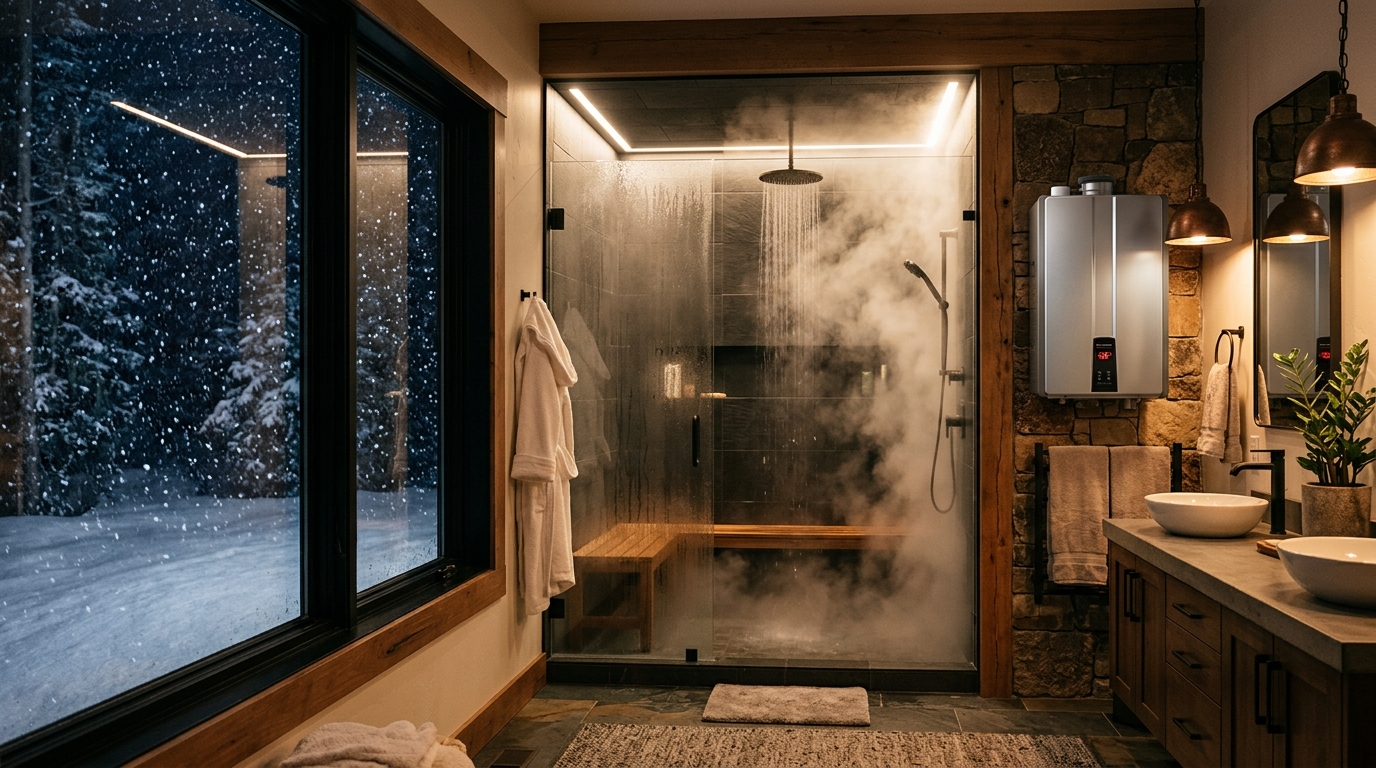
The 40°F Colorado Groundwater Reality: Understanding Delta-T
The fundamental metric determining whether a tankless water heater can satisfy your family's needs is "Delta-T" (ΔT)—the difference between incoming municipal cold water temperature and your desired output temperature (typically set to 120°F to prevent scalding).
In mild climates like Florida or Southern California, municipal ground water enters homes at 65°F to 72°F year-round, requiring a modest 48°F to 55°F temperature rise. However, in Brighton, winter groundwater piped from surface reservoirs and alluvial wells drops to 38°F to 42°F between November and March. To raise 40°F water up to a comfortable 120°F shower temperature requires a massive 80°F Delta-T rise.
Because a tankless unit heats water instantly as it passes through narrow copper or stainless steel heat exchangers, heating capacity is strictly limited by burner BTU input. A tankless unit rated for 9.5 gallons per minute (GPM) in Florida may only deliver 4.2 GPM during a January blizzard in Brighton. Understanding this distinction prevents homeowners from suffering sudden water temperature drops when running multiple fixtures simultaneously.
High-Altitude Combustion Derating at 5,000 Feet Elevation
Brighton rests at an official elevation of 4,984 feet above sea level. At this altitude, barometric air pressure is approximately 17% lower than at sea level, meaning each cubic foot of ambient air contains fewer oxygen molecules to support fuel combustion.
Under International Fuel Gas Code (IFGC) standards, non-condensing atmospheric gas appliances must be derated by 4% for every 1,000 feet of elevation above sea level when operating above 2,000 feet. For modern condensing tankless systems like Navien NPE-240A2 or Rinnai RU199iN, onboard computer blowers automatically adjust fan speed and gas mixture to compensate. However, total maximum BTU output can still experience an effective 6% to 10% thermal reduction at high elevations compared to sea level test ratings.
When sizing a tankless water heater installation in Brighton, our technicians account for both 80°F winter temperature rise and 5,000-foot altitude factors. This ensures your home maintains adequate continuous flow to operate two showers and a kitchen sink simultaneously, even during below-zero Arctic cold snaps.
Head-to-Head: Tankless vs. High-Efficiency Storage Tank
Both water heating technologies offer distinct advantages depending on your household size, available gas line capacity, and budget:
| Performance Metric | Condensing Tankless (e.g. Navien/Rinnai) | Standard Gas Storage Tank (e.g. Bradford White) |
|---|---|---|
| Uniform Energy Factor (UEF) | 0.95 to 0.97 (Ultra-High Efficiency) | 0.62 to 0.68 (Standard Atmospheric) |
| Winter Flow Capacity (at 80°F Rise) | 4.5 to 5.2 GPM Continuous (Endless) | 50 Gallon Dump (approx. 18-22 mins hot water) |
| Gas Line Requirement | Typically 3/4" dedicated gas line (199k BTU) | Standard 1/2" gas line (38k to 40k BTU) |
| Expected Equipment Lifespan | 20 to 25 Years (with annual flushing) | 8 to 12 Years in Adams County hard water |
| Physical Space Footprint | Wall-mounted, 0 sq ft floor space | 12 to 16 sq ft floor space in basement/utility room |
| Venting Construction | Direct two-pipe PVC/polypropylene out sidewall | Vertical metal B-vent chimney through roof |
| Routine Maintenance Required | Annual vinegar/descaling flush & filter cleaning | Annual tank bottom sediment drain & anode checks |
Gas Supply Line Capacity: Why 1/2-Inch Pipes Starve Tankless Units
One of the most frequent technical mistakes made during unpermitted tankless installations in Adams County is attempting to connect a 199,000 BTU on-demand heater to an existing 1/2-inch black iron gas branch.
Standard 40-gallon atmospheric storage tanks burn approximately 36,000 to 40,000 BTUs per hour, which a 1/2-inch pipe can safely deliver over distances up to 40 feet. In sharp contrast, a whole-house tankless water heater requires an instantaneous burst of 180,000 to 199,000 BTUs—roughly the equivalent energy consumption of two central home heating furnaces firing simultaneously.
Under International Fuel Gas Code (IFGC) pipe sizing tables, delivering 199,000 BTUs across typical residential distances requires a dedicated 3/4-inch or 1-inch gas line directly from the main gas manifold. If a tankless unit is starved for gas volume during peak winter demand, the internal burner experiences severe flame flutter, incomplete combustion, heavy soot accumulation, and recurrent digital error codes (such as Navien E003 or Rinnai 11). Before scheduling installation, a certified plumbing technician must calculate the total equivalent pipe length and ensure the Xcel Energy municipal gas meter regulator provides adequate supply pressure.
Recirculation Loops & Freeze Protection in Front Range Basements
Because Brighton winter temperatures routinely drop below zero, installing a tankless water heater requires dedicated attention to freeze protection and distribution efficiency.
Premium condensing units come factory-equipped with internal ceramic electric heating blocks designed to prevent heat exchanger freeze damage down to -22°F. However, these safety mechanisms depend completely on continuous 120-volt electrical power. If an Arctic storm knocks out power lines across Adams County, an uninsulated or poorly placed unit can freeze and split its copper coils within hours. Plumbers recommend installing mechanical auto-drain solenoid valves that dump water harmlessly onto a floor drain if electrical power is lost during sub-freezing weather.
Additionally, because tankless units do not store pre-heated water, installing a dedicated hot water recirculation loop with an intelligent scheduling pump delivers instant hot water to distant bathroom fixtures in neighborhoods like Brighton East Farms or Platte River Ranch, saving thousands of gallons of municipal water every year while eliminating frustrating wait times.
Long-Term Cost Analysis and Financial Payback in Adams County
While a tankless installation requires a higher initial investment due to electrical outlet additions, gas line upsizing, and dedicated sidewall PVC venting, the operational economics favor tankless systems over their 20-year lifespan.
A typical Brighton family of four spends approximately $380 to $460 annually heating domestic water with a standard gas storage tank. Because a tankless system burns gas only when an active faucet calls for hot water—eliminating continuous 24/7 standby thermal losses through the flue—gas consumption drops by 25% to 35%, generating $100 to $150 in annual utility bill savings.
In addition, qualifying high-efficiency tankless models earn significant federal Energy Star tax credits under the Inflation Reduction Act (up to $600) and local utility rebates from Xcel Energy and United Power. When combined with lasting twice as long as a traditional storage unit, tankless systems deliver compelling financial and performance benefits for long-term Adams County homeowners.
Frequently Asked Questions
Will my shower go cold if someone starts the dishwasher with a tankless unit?
Not if the unit is sized properly for Brighton's winter climate. A 199,000 BTU condensing model delivers approximately 4.8 GPM at an 80°F rise, which comfortably powers a 2.0 GPM shower and a 1.5 GPM dishwasher without temperature fluctuations.
What is the 'cold water sandwich' effect on tankless water heaters?
If you turn the shower off briefly while shampooing and turn it right back on, a small pocket of unheated water already inside the pipes reaches you between hot streams. Premium models equipped with internal buffer tanks and recirculation pumps eliminate this issue completely.
Can I install a tankless water heater in an unheated garage in Brighton?
While tankless units feature internal electric freeze-protection elements, installing them in unconditioned spaces where temperatures plunge below zero risks catastrophic heat exchanger freezing if power fails. Installation inside basements, mechanical rooms, or conditioned closets is strongly recommended.