
Understanding South Platte Water Hardness in Adams County
Water utility reports for the City of Brighton indicate average mineral hardness levels between 210 and 310 milligrams per liter (mg/L), which translates mathematically to 12.3 to 18.1 grains per gallon (GPG). According to the United States Geological Survey (USGS) water classification scale, any water measuring over 10.5 GPG is categorized as "very hard." In newer subdivisions like Brighton Crossings and established communities like Bromley Park, this dissolved calcium carbonate (CaCO3) remains invisible in cold water, but behaves aggressively once thermal energy is applied.
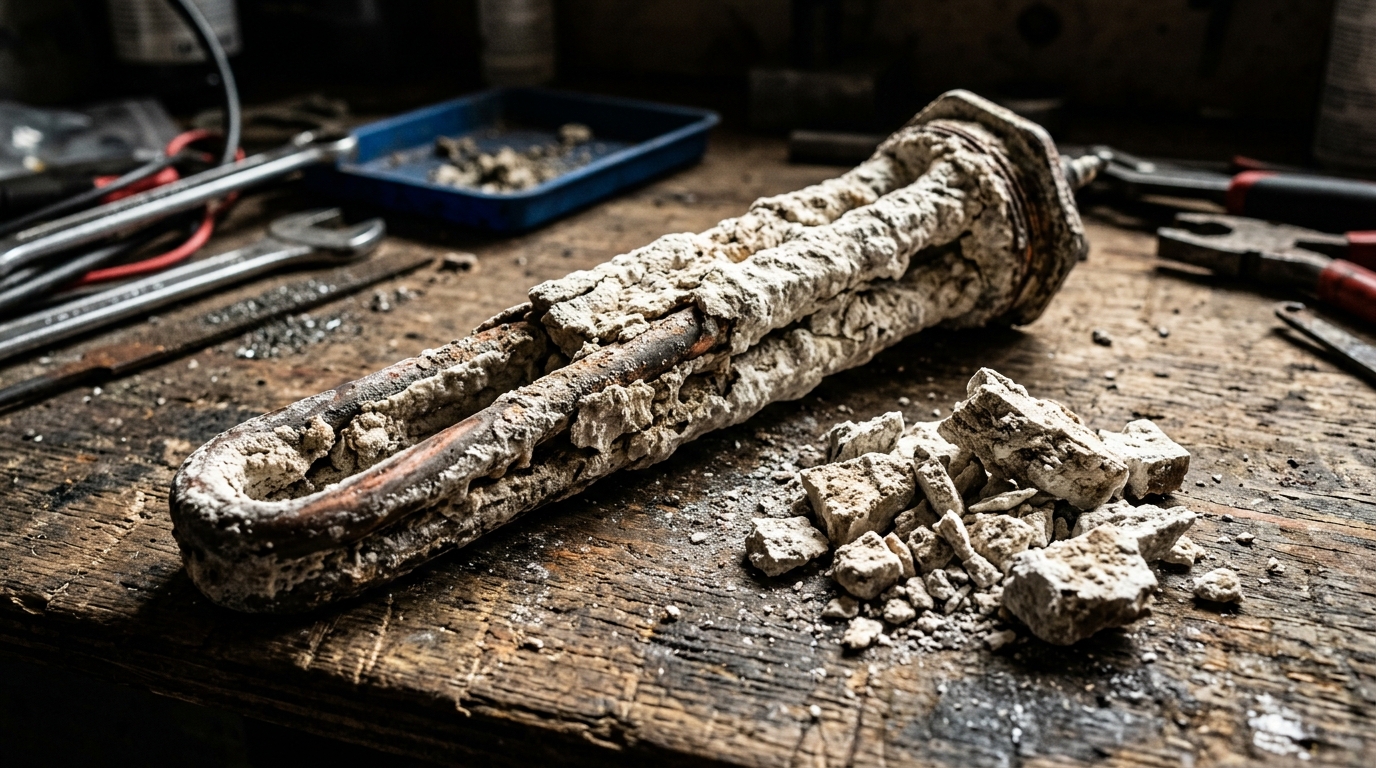
When cold water enters your water heater and warms above 120°F, the calcium bicarbonate dissolved in the liquid chemically precipitates into solid calcium carbonate crystals. Because heating surfaces—whether natural gas tank bottoms or 240-volt electric immersion elements—represent the hottest physical points in the system, mineral solids adhere directly to these components first. Over months of thermal cycling, microscopic crystals coalesce into dense limestone scale that coats interior surfaces.
Four Ways Mineral Scale Destroys Water Heating Equipment
Homeowners frequently assume hard water merely leaves white spots on drinking glasses or shower doors. However, inside a pressurized water heater, mineral buildup triggers four destructive mechanical failure cycles:
1. Thermal Insulation and Tank Bottom Overheating: In gas-fired storage tanks, scale settles at the concave bottom head directly above the 40,000 BTU burner assembly. Calcium carbonate acts as an effective thermal insulator with very low thermal conductivity. Instead of heat passing efficiently into the water, the flame heat is trapped in the steel tank bottom. The tank metal temperature spikes from a normal 160°F to over 450°F, softening the structural steel and burning away the internal protective vitreous porcelain enamel (glass lining). Once the glass lining micro-fractures, bare steel contacts oxygenated water, sparking rapid rust perforations.
2. Electric Element Thermal Stress and Dry-Fire Burnout: In electric systems, mineral crust adheres directly around upper and lower resistance elements. As the scale layer thickens past 1/8 inch, the electric element cannot dissipate its 4,500 watts of heat into the surrounding water. Internal copper core temperatures skyrocket until the resistance alloy melts and snaps, resulting in a sudden complete loss of hot water. Replacing elements without flushing the surrounding mineral sludge guarantees the replacement element will fail within months.
3. The Destructive 'Kettling' Phenomenon: When water becomes trapped in microscopic pockets underneath a thick sediment blanket at the bottom of a gas tank, it reaches its boiling point before the surrounding bulk water. The trapped water flashes into steam bubbles, which violently collapse as they escape into the cooler water above. This generates popping, rumbling, banging, or crackling noises commonly referred to in the plumbing trade as "kettling." Beyond the disturbing noise, the hydraulic shockwaves flex the steel tank shell repeatedly, weakening welded seams until a catastrophic flood occurs.
4. Premature Sacrificial Anode Rod Depletion: Water heaters rely on an interior magnesium or aluminum sacrificial anode rod to attract corrosive electrochemical reactions away from the tank walls. High mineral concentrations dramatically increase the electrical conductivity of water, speeding up the chemical consumption of the anode rod. In Brighton, factory-installed anode rods that normally last five years are frequently eaten down to the bare steel core wire in fewer than 24 months, leaving the tank shell completely unprotected against galvanic corrosion.
The Adams County Water Heater Protection Strategy
Preventing premature replacement requires a proactive mechanical defense. Master plumbers recommend three foundational actions for every Brighton residence:
| Maintenance Action | Recommended Frequency | Primary Benefit for Brighton Homes |
|---|---|---|
| Annual Full-Port Hydro-Flush | Every 12 Months | Purges loose calcium sand before it calcifies into hardened rock plates at the tank base. |
| Anode Rod Inspection & Replacement | Every 2 to 3 Years | Replaces depleted magnesium rods with zinc-aluminum hybrid rods to stop tank wall pitting. |
| Tankless Heat Exchanger Vinegar Flush | Every 12 Months | Circulates virgin food-grade descaling solution to dissolve scale inside narrow copper coils. |
| Whole-Home Water Softener Installation | Permanent Solution | Exchanges calcium and magnesium ions for sodium, eliminating 99% of scale formation entirely. |
If your water heater already produces rumbling sounds or cloudy white sediment in sink aerators, standard garden-hose draining is rarely sufficient. Settled calcium chunks clog standard 3/4-inch plastic drain spigots immediately. Professional sediment flushing services use commercial full-port brass discharge assemblies and motorized agitation equipment to break apart hardened mineral deposits and extract them safely.
Should You Add a Water Softener in Brighton?
Installing an ion-exchange water softener is the single most effective way to protect modern plumbing fixtures, dishwashers, and water heaters across Adams County. However, softeners introduce an important consideration that many homeowners overlook: softened water contains dissolved sodium chloride ions, which slightly increases electrical conductivity.
Because softened water accelerates the galvanic dissolution rate of standard magnesium anode rods, water heater warranties often require checking the sacrificial anode rod every 18 months when a softener is operating. Upgrading to a powered titanium electronic anode rod provides indefinite electrochemical protection without deteriorating or producing foul sulfur odors.
Frequently Asked Questions
Can vinegar dissolve hardened sediment inside a storage tank?
Vinegar works effectively for descaling tankless heat exchangers where fluid can be actively pumped through small passages. However, for a 50-gallon tank containing 30 pounds of hardened calcium rock, vinegar lacks the concentration and volume needed. Mechanical agitation and high-pressure flushing are required.
Why is my hot water smelling like rotten eggs in Brighton?
When hard water minerals react with standard magnesium anode rods and naturally occurring sulfate-reducing bacteria in municipal aquifers, hydrogen sulfide gas is created. Replacing the magnesium rod with an aluminum-zinc alloy rod typically eliminates the odor permanently.
How do I know how much sediment is inside my water heater?
Place your hand carefully on the lower third of the tank jacket during a heating cycle. If the upper section feels warm but the lower 10 inches feels cool or vibrates with popping sounds, a substantial sediment blanket has accumulated.